You have come across the words "Profhilo" and "Dermal Fillers" at your skin care clinic, on your social media platforms, or in other online forums. While they may be used interchangeably in many conversations, there is a difference between the two products. Both treatments use injectables, including hyaluronic acid, and claim to deliver rejuvenated, smoother …

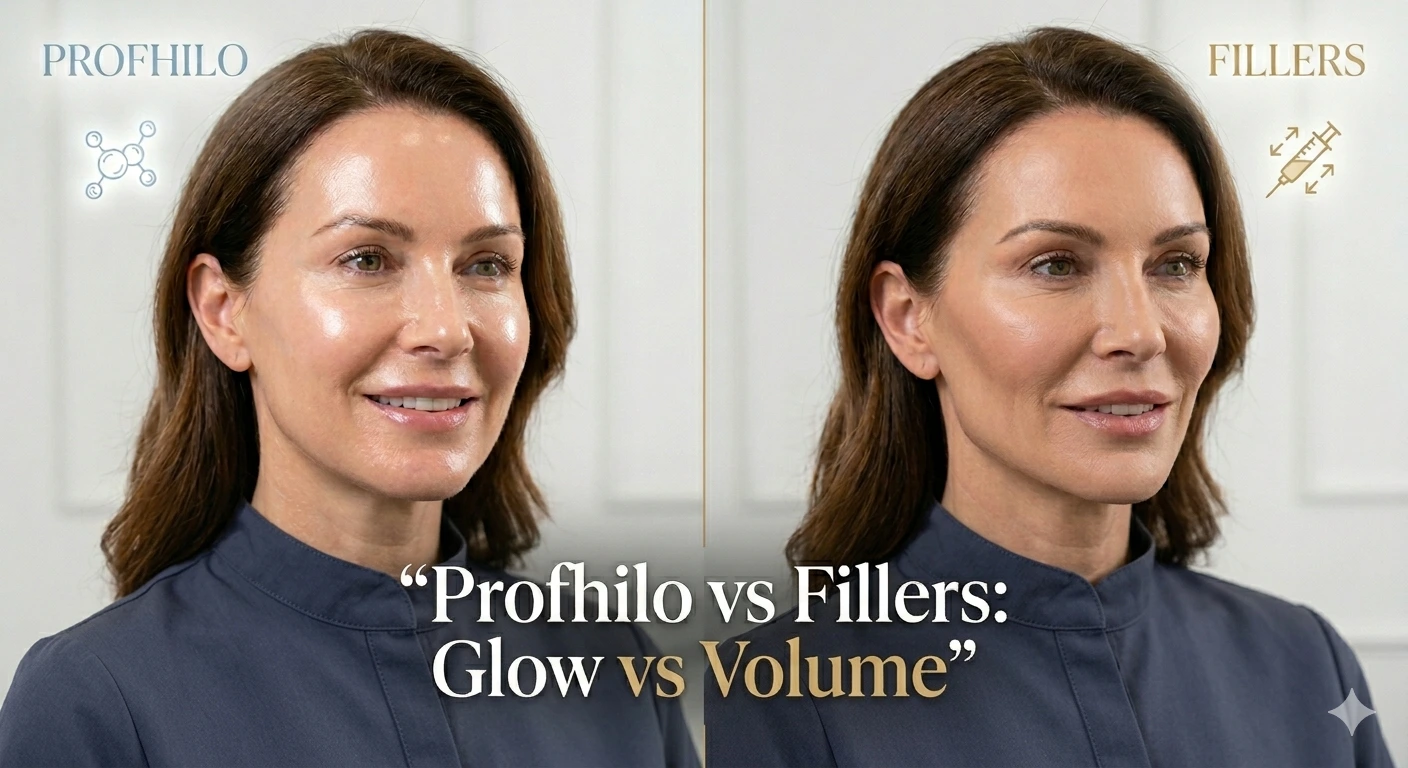
You have come across the words “Profhilo” and “Dermal Fillers” at your skin care clinic, on your social media platforms, or in other online forums. While they may be used interchangeably in many conversations, there is a difference between the two products. Both treatments use injectables, including hyaluronic acid, and claim to deliver rejuvenated, smoother skin.
In this blog, we discuss what these treatments are, their differences, and who the ideal candidate is for each.
What is Profhilo Treatment?
Profhilio treatment is a skin booster that contains a high concentration of pure hyaluronic acid (HA), 64mg in only 2 ml. It acts as a fluid beneath the skin, stimulating the formation of collagen and elastin. Generally, Profhilo procedures are performed at five points on either side of the face, called the BAP (Bio Aesthetic Point) procedure. The injections are quick (less than 30 minutes), and you need no downtime. In addition, results will gradually improve over the next four to eight weeks. Profhilo injections work biologically, i.e., they hydrate your skin and stimulate the production of new cells, resulting in a rejuvenated look.
What are Dermal Fillers?
Fillers are gel injections, usually made of cross-linked hyaluronic acid, that serve to volumise and contour a specific area. Whatever purpose it serves, be it for lip enhancement, cheekbone lifting, minimising nasolabial folds, or jawline sculpting, there is a specific effect of filler.
The cross-linking process forms a strong HA gel that is resistant to degradation and helps build structure within the filler itself. Fillers are specific and localised, and they act immediately upon injection.
Key Differences between Profhilo Treatment and Dermal Fillers
1. The Nature of Hyaluronic Acid
This is where everything starts. Profhilo doses use uncross-linked HA that is part of a hybrid complex of high- and low-molecular-weight chains. Such a composition enables the treatment to flow easily within tissues, hydrate, and activate self-healing processes.
Cross-linking HA chains creates a gel that is structurally rigid and retains its volume and shape. This allows dermal fillers to be sculpted in place and provide lift.
2. They Function in Completely Different Ways
Injections of Profhilo function as bio-stimulation products. As opposed to volumising, Profhilo diffuses into the subcutaneous layer, triggering your body’s natural production of four kinds of collagen and elastin. The benefits take some time to be visible; it generally takes two rounds of treatment, four weeks apart, for maximum effect.
Filler injections are more instant and accurate. You come in with hollow cheeks; you leave with pronounced features. The effects are immediate and usually last from six to eighteen months.
3. When Are They Needed
Treatment with Profhilo injections works best on skin with laxity and a general loss of quality; in other words, areas like the face, neck, chest, and hands are the most common targets. Profhilo isn’t designed to target specific areas with pinpoint accuracy; it’s intended for large-scale skin rejuvenation.
Dermal fillers are much more precise. They are used to address specific issues, including lip contouring, eye bags, marionette lines, temples, jowls, and other areas. The cosmetic injection is carefully delivered into the required area of the face.
4. Different Advantages
Patients won’t notice any immediate changes after using Profhilo treatment, but they will see improvements in their skin’s overall appearance over time. The procedure will improve its tightness, texture, hydration, elasticity, and natural glow.
However, the benefits of dermal fillers appear quickly and are easily noticeable to patients. There’s a restoration of the volume levels, better-defined contours, and removal of certain fine lines and hollow areas of their faces. Fillers work wonders for people who have lost facial volume due to ageing, as shown in market statistics.
So…Which One Is It?
- Let’s make this simple: do you find yourself saying…
- “My skin appears lacklustre, fatigued, or slightly loose?”, go with Profhilo
- “I lack volume or need some definition?”, go with fillers
- For glow: go with Profhilo treatment
- For shape: go with fillers
What about both of those? Not a problem!
Both at Once?
Sure thing! Patients commonly use both in combination. Profhilo methods are generally used as a base layer to treat skin quality issues, while fillers are used as a second layer to treat structural issues. They together create outcomes unattainable by one alone.
Remember, it’s all about knowing what your skin needs. A Profhilo treatment will not give you high cheekbones, but fillers won’t restore that dewy, plumped-up look either.
How Long Do Profhilo and Fillers Last?
The question that arises in everyone’s mind when opting for any injectable procedure is, “How long will the results last?” When discussing the duration of the effects of Profhilo and dermal fillers, longevity is another key factor that distinguishes the two products.
For Profhilo injections, the treatment regimen begins with two treatments administered 4 weeks apart. This bi-weekly treatment plan forms the backbone for bio-reconstruction. The next step to sustain this collagen-stimulation effect is to follow up with maintenance sessions every 6 months.
Profhilo stimulates collagen production within the skin rather than physically filling it; hence, the effects do not dissolve as quickly and last until your natural collagen production fades.
The longevity of dermal fillers depends on the type of product used, the treated area, and your metabolism. Below is an approximate time frame for various types of fillers.
- Lip fillers: 6 to 9 months (as lips are an active area, the filler product gets dissolved sooner)
- Cheek fillers: 12 to 18 months
- Jawline fillers: up to 18 months
- Undereye fillers: 9 to 12 months
Who is the Ideal Candidate?
It’s one thing to comprehend the difference between Profhilo and fillers, but it’s quite another to know which one will work best for you. Luckily, both procedures have their own patient types, making it relatively easy to find out where you fit.
A Profhilo treatment may be perfect for you if:
- You’re a woman between the ages of 28 and 50 who has noticed that her skin feels less firm, taut, or hydrated than it used to
- The issue with your skin that you’d like to address isn’t specifically about wrinkles, but more about the overall quality of your skin
- You want natural-looking results, without any sign of “filler” appearance
- Prevention is a key motivation for you, in addition to improvement
- You are dealing with loose skin issues in areas of the body other than the face, such as the neck, décolletage, or hands.
If you are a good candidate for dermal fillers, you will:
- Have observed volume loss in particular areas, like cheek hollowing, lip thinning, temple indentations, or nasolabial folds
- Looking for instant and noticeable results
- Interested in achieving definition on certain features, like a protruding chin, chiselled jawline, or plump lips
- Willing to undergo a procedure that requires proper administration and gives you a defined look afterwards
And may need both if:
- You suffer from skin quality and volume loss, quite common in people above the age of 35
- Need a method to reverse ageing on a deeper and skin-level perspective
The Bottom Line
What are the differences between Profhilo and fillers? Simply put, one is a skin remodelling treatment, while the other is a sculpting treatment. Profhilo is perfect for anyone with skin quality issues, such as a lack of elasticity, dull skin, or general ageing.
Profhilo injections operate at the cellular level, initiating your skin’s natural rejuvenation process, allowing you to anticipate enduring results. Dermal fillers are best for people with volume loss or who wish to define their facial structure. There is no “better” option. They are simply used for different things. But recognising the distinction will help you make informed decisions based on your unique needs.
Book an Appointment
It’s easy and free!